

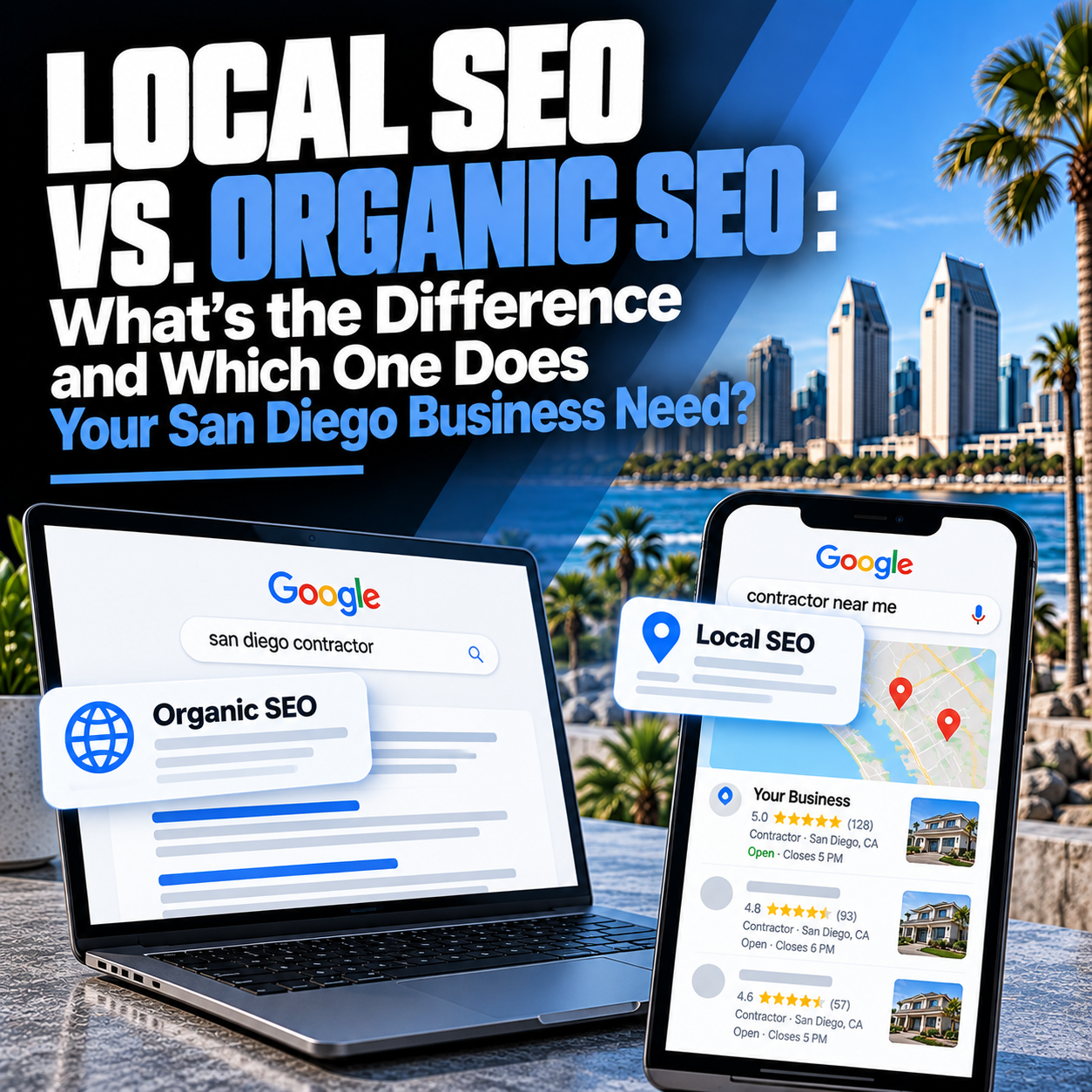
Most San Diego business owners have heard that they need SEO. Fewer understand that there are two fundamentally different types of SEO — and that confusing them leads to spending money on the wrong one. Local SEO and organic SEO use overlapping techniques but target completely different outcomes. Choosing the right one (or the right mix of both) is one of the first decisions worth getting right.
We’ve been doing SEO for San Diego businesses since 2011, and this is one of the most common points of confusion we clear up in early conversations. This guide lays out exactly what each type is, how they differ, and how to figure out which approach your business actually needs.
What is organic SEO?
Organic SEO is the process of ranking your website’s pages in Google’s standard (non-map, non-paid) search results — the blue links that appear when someone searches for information, a service, or a product. These results are ranked based on a combination of content relevance, website authority, page experience, and hundreds of other signals Google evaluates.
When you rank organically, your website appears because Google’s algorithm has determined that your page is one of the best answers to a searcher’s query — not because you paid for the placement, and not exclusively because of your physical location. A San Diego-based company ranking organically for “how to choose a marketing agency” could attract visitors from across the country. The geographic constraint is looser because the intent of the search is informational rather than location-dependent.
Organic SEO is built through a combination of technical website health, high-quality content that answers questions in your industry, and inbound links from other reputable websites. It compounds over time — a page that ranks well this year tends to keep ranking (and improving) as it accumulates more signals, unlike paid ads that stop the moment you stop paying.
What is local SEO?
Local SEO is specifically about ranking in location-based search results — the map pack (the three businesses that appear in a box at the top of Google results, often with a map), plus the local organic results that follow beneath them. It’s what gets your business found when someone searches “plumber near me,” “dentist in La Jolla,” or “best Italian restaurant San Diego.”
Local SEO results are determined by a different set of signals than standard organic SEO. Google’s local ranking algorithm weighs three factors heavily: relevance (how well your business matches the search), distance (how close you are to the searcher), and prominence (how well-known and authoritative your business is online). Your Google Business Profile — not just your website — is the primary vehicle for local SEO, alongside citations (consistent business listings across directories) and Google reviews.
Local SEO matters most when the person searching has clear local intent. They’re not looking for general information about a service — they’re looking for a business to hire right now, in a specific area. For most service businesses in San Diego, this is the majority of their valuable search traffic.
The clearest way to see the difference
Search “how to fix a leaky faucet” and you’ll see organic results — how-to articles, YouTube videos, DIY guides. The searcher wants information, not a plumber to call. Geography doesn’t show up in these results because it doesn’t matter where you are to read a how-to article.
Now search “plumber San Diego” or “plumber near me” and you’ll see a map with three local businesses listed, plus reviews, hours, and a phone number. That’s local SEO. The intent is transactional and location-specific.
Both types of search traffic are valuable — but they serve different stages of the customer journey, and they require different strategies to capture.
Key differences between local SEO and organic SEO
Where results appear
Organic SEO targets the standard blue-link results that appear below the map pack. Local SEO targets the map pack (the three-result box with a Google map), along with local business listings that can appear in the organic section for location-specific queries. A business can appear in both places — and the top local SEO performers often do — but the strategies to get there are different.
What Google uses to rank you
Organic SEO rankings are primarily driven by your website’s content quality, technical health, and how many reputable sites link to yours. Local SEO rankings are driven by your Google Business Profile completeness and activity, your NAP (Name, Address, Phone) consistency across the web, your volume and recency of Google reviews, and local citations.
Your website still matters for local SEO — particularly for the organic local results that appear below the map — but the Google Business Profile is the center of gravity in a way it simply isn’t for standard organic rankings.
Geographic reach
Organic SEO can reach people anywhere. A San Diego law firm ranking organically for “employment law for remote workers” could get traffic from Chicago or Boston. Local SEO, by contrast, is geographically bounded — you’re competing to appear for people searching in or near your service area. For a neighborhood restaurant or a licensed contractor who only works in San Diego County, that boundary is exactly what you want. For a SaaS company or an online retailer, it’s limiting.
Timeline to results
Both take time, but local SEO can show movement faster. A fully optimized Google Business Profile with a strong review velocity can start improving map pack rankings in weeks. Organic SEO is generally a 3-6 month effort before meaningful ranking changes occur, with compounding returns over 12-24 months for competitive terms.
What you’re optimizing
Organic SEO is primarily a website and content discipline. You’re optimizing pages on your site — their structure, their content, their speed, their internal and external links. Local SEO requires managing your Google Business Profile as an active marketing asset (posting, responding to reviews, keeping hours updated, adding photos), maintaining consistent business information across dozens of directories, and building a steady stream of authentic Google reviews.
Which one does your San Diego business actually need?
The answer depends on who your customers are and how they find you.
You primarily need local SEO if:
Your customers are looking for a business in a specific area — your value proposition is being local. This applies to most San Diego service businesses: plumbers, HVAC contractors, dentists, chiropractors, attorneys, restaurants, auto shops, cleaning services, landscapers. If someone is searching with “near me” or “San Diego” as part of their query, and you’re the answer, local SEO is your priority. The map pack is often where most of your valuable clicks come from, and it’s where your local SEO investment should be focused.
You primarily need organic SEO if:
You serve clients anywhere (not just locally), you sell online, or you want to attract customers who are earlier in their research process. A San Diego-based digital marketing agency, for example, might serve clients in Los Angeles, Phoenix, or nationwide — local SEO alone won’t help with those searches. A content strategy that ranks for terms like “how to choose an SEO agency” or “what does a digital marketing agency do” reaches potential clients wherever they are. Our own San Diego SEO services blend both: ranking locally for clients who want a nearby agency, and organically for research-phase searches.
Most San Diego businesses need both
The most effective approach for a local service business is a combination: local SEO to capture high-intent “near me” searches that convert quickly, and organic SEO to build informational content that attracts customers earlier in their journey. These aren’t competing strategies — they reinforce each other. A strong local SEO presence helps organic rankings. Strong organic content signals to Google that your website is an authoritative resource in your field, which supports local visibility.
The balance shifts based on business type. A restaurant leans heavily local. A law firm with a national niche practice needs more organic investment. A contractor serving just San Diego County should prioritize local but not ignore content entirely. We help each client find the right balance based on where their actual customers come from.
Common mistakes we see in San Diego
Investing only in the website and ignoring the Google Business Profile
Many businesses spend money on a new website and technical SEO while their Google Business Profile sits with outdated information, no posts, and a handful of old reviews. For local search, this is backwards. The GBP is the front door for local intent searches. A neglected profile loses map pack rankings regardless of how good the website is.
Treating all links as equivalent
Local citations (consistent listings on Yelp, the BBB, industry directories, and similar) help local SEO but don’t move organic rankings the way editorial links from real websites do. Business owners sometimes invest heavily in citation building and expect broader organic ranking improvements — those are different outputs of different link types.
Writing generic blog content with no local angle
A lot of SEO content for local businesses is generic — “how to fix your roof” written by a San Diego roofing company with no mention of San Diego-specific weather, permitting, or neighborhoods. That content competes against national publications with far more authority. Local angle and specificity are advantages local businesses can win on. A San Diego HVAC company that writes about how marine layer humidity affects AC efficiency and what to expect during a heat wave in East County is covering ground no national publication bothers with.
Skipping review strategy
Reviews are one of the most underutilized local ranking signals. Google’s local algorithm weighs review volume, recency, and sentiment. A business with 12 reviews from 3 years ago is losing map pack ground to a competitor who consistently earns 5-10 fresh reviews per month. A proactive review strategy isn’t optional for competitive local niches.
How to know if your current SEO is working
For local SEO, the right metrics are: map pack position for your primary service + location terms, inbound calls and direction requests from Google Business Profile Insights, and the number of reviews earned per month compared to your competitors. For organic SEO, the metrics are: keyword rankings for target terms, organic traffic to key service pages, and leads or conversions originating from organic search.
If you’re not tracking both sets of metrics separately, you can’t tell which type of SEO is delivering and which needs attention. We build this reporting for every client from month one so the data actually reflects the investment being made. A free SEO audit is a good starting point to see where you currently stand on both fronts before making decisions about budget allocation.
Frequently asked questions about local SEO vs. organic SEO
Can I rank in the map pack without doing organic SEO?
Yes — the map pack and organic results use different ranking systems. You can rank well in the map pack through Google Business Profile optimization and review building without a comprehensive organic content strategy. That said, the local organic results below the map pack do depend on your website’s SEO. Businesses that rank in both places (map pack and local organic) tend to see significantly more clicks than those appearing in only one.
Does a new San Diego business need local SEO or organic SEO first?
For most new local service businesses, local SEO should come first. It can produce results faster, it directly targets the high-intent searches most likely to convert, and it requires resources (Google Business Profile, review strategy) that cost less to start than a full content marketing program. Organic content can be layered on once local rankings and review volume are established.
Does my website matter for local SEO?
Yes, it does — especially for the organic local results that appear below the map pack. Google wants to confirm that your website matches what your Google Business Profile claims: same business name, address, phone number, and consistent services. Service pages that mention the cities you serve and include location-specific content help local rankings. A technically broken or extremely thin website can limit local SEO performance even if the GBP is well-optimized.
How much does local SEO cost compared to organic SEO?
Costs vary depending on competitiveness and scope, but local SEO is often a lower monthly commitment than a full organic content and link-building program. Local SEO requires ongoing GBP management, review strategy, and citation maintenance. Organic SEO at a competitive level requires consistent content production and link acquisition, which tends to cost more. Many agencies bundle both — we do — with the split determined by the business type and where the biggest opportunity sits.
Can paid Google ads replace SEO?
Paid ads (Google Ads and Google Local Services Ads) can drive leads while you’re building organic and local rankings, but they don’t replace the long-term compounding value of SEO. Ads stop the moment you pause spending. Organic rankings built through SEO continue delivering traffic without per-click cost. Most competitive San Diego businesses use both — paid for immediate leads, organic and local SEO for sustainable growth.


