

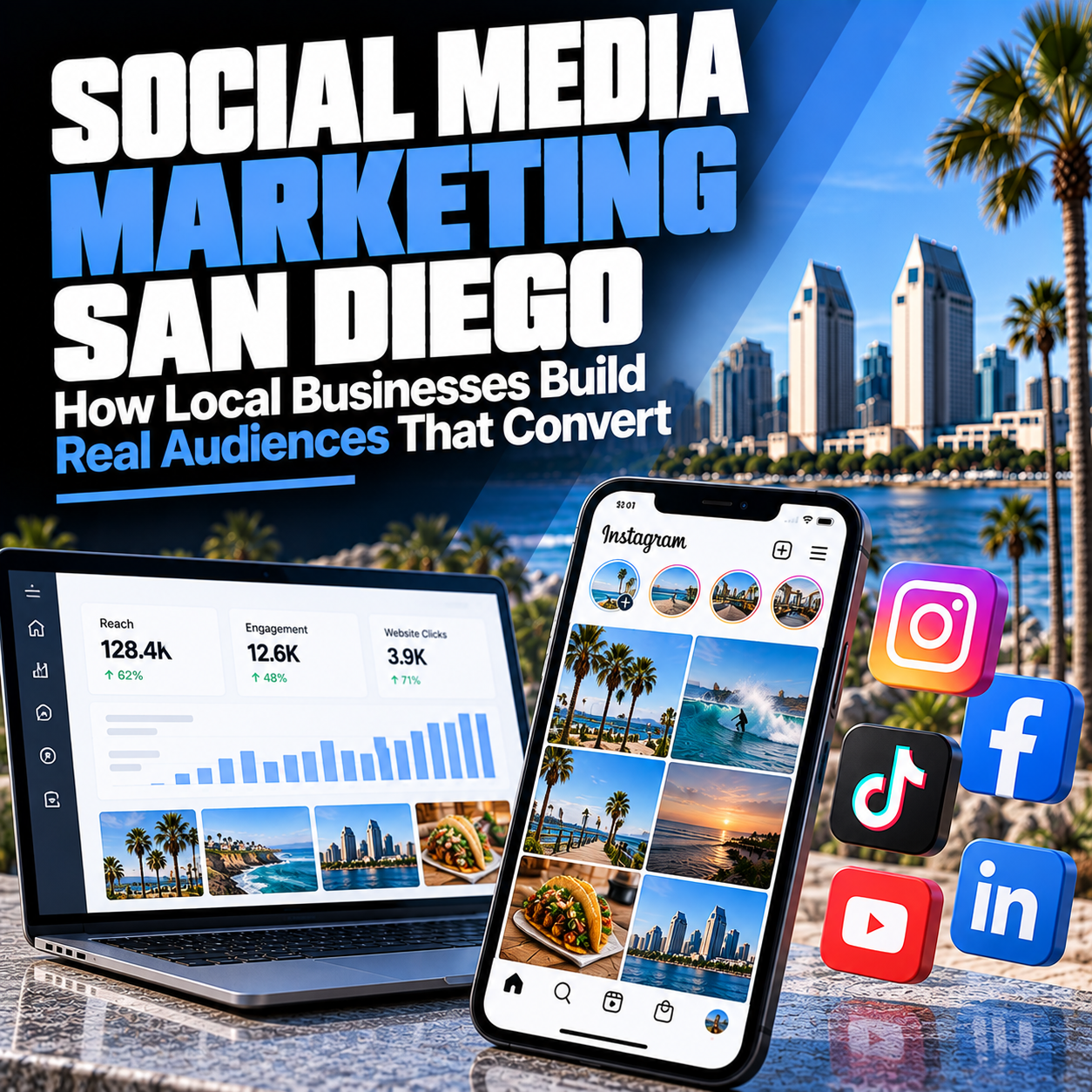
San Diego is one of the most active social media markets in the country — and one of the most competitive for local businesses trying to use it effectively. The challenge isn’t that social media doesn’t work here. It’s that most of what passes for social media marketing doesn’t actually produce leads. Posting three times a week with stock photos and generic captions builds neither an audience nor a pipeline.
We’ve been running social media marketing for San Diego businesses since 2011 — restaurants in the Gaslamp, contractors in Chula Vista, medical practices in La Jolla, retail in the East Village. What drives results looks different from what most social media guides recommend. This is what we’ve found actually works in this market.
Why San Diego is different for social media marketing
San Diego’s social media landscape has some specific characteristics worth understanding before building a strategy.
The market is geographically dispersed across distinct communities — coastal neighborhoods like La Jolla, Pacific Beach, and Ocean Beach operate differently from inland communities like Santee, El Cajon, or Chula Vista. A business that resonates with one may not automatically translate to others. Geographic targeting in Meta Ads and neighborhood-level messaging in organic content matter more here than in a more compact city.
San Diego’s outdoor and lifestyle culture is a content opportunity that local businesses consistently underuse. The proximity to beaches, trails, and year-round outdoor conditions gives local businesses a contextual backdrop that most markets don’t have. A San Diego landscaping company talking about what grows well in the coastal microclimate, or a fitness studio promoting morning outdoor workouts in winter when the rest of the country is frozen, has a natural angle that doesn’t need to be manufactured.
The military community in San Diego (one of the largest concentrations in the US) is a specific audience segment worth targeting for businesses in certain verticals — housing, financial services, food, entertainment, retail. Military-adjacent messaging and targeting considerations don’t come up in generic social media guides but matter significantly for businesses in proximity to Coronado, National City, or Kearny Mesa.
What social media marketing actually involves
When we talk about social media marketing, we mean a combination of things that need to work together to produce consistent results for a San Diego business:
Content strategy and production
Content strategy starts with deciding what your business is trying to accomplish on social media — lead generation, brand awareness, customer retention, or some combination — and working backward from that to determine what content serves those goals. For a San Diego service business, that’s usually a mix of work showcase content (real project photos and videos), educational content that answers the questions your customers are already asking, and social proof content (reviews, customer stories, before/after results).
Production is the execution — writing captions, creating graphics, editing short-form video, scheduling posts through a management platform, and maintaining a content calendar that’s planned a month in advance. Without a calendar, social media becomes reactive and inconsistent, which undermines both the algorithm and the audience relationship.
Platform management
Active platform management means more than scheduling posts. It means responding to comments and DMs within a reasonable window (a slow response to a sales inquiry from a social media post is a lead lost), engaging with local community content and partner accounts, and keeping profile information current. Platforms penalize inactive accounts and reward consistent engagement signals in their content distribution algorithms.
Paid social media advertising
Organic social media reach on Facebook and Instagram has declined significantly over the past several years as both platforms have shifted to favor paid content distribution. For San Diego businesses trying to generate measurable leads from social media, Meta Ads are no longer optional — they’re the engine that makes the strategy work at scale.
Our San Diego social media marketing service integrates organic and paid together because that’s how results compound: organic content builds brand familiarity and trust over time, while paid ads capture leads from people in your target area who are ready to act. Using paid ads without organic content reduces ad effectiveness. Using organic content without paid ads limits your reach to your existing audience.
The platforms that matter most in San Diego
Instagram is the highest-priority platform for most San Diego local businesses. It’s visual-first, which suits service businesses that can show their work (contractors, restaurants, fitness, medical/aesthetics, retail), and the San Diego audience is highly active here. Reels (short-form video) now drive the most organic reach on the platform. Stories are the right format for time-sensitive content like offers, availability, and behind-the-scenes glimpses. Static posts are still relevant for portfolio-style showcase content and quotes/educational posts.
Facebook’s organic reach is limited for business pages, but it remains essential for two reasons: it’s where Meta Ads live, and it’s still the dominant platform for the 40-65 age demographic that makes up a large portion of homeowners, decision-makers, and higher-income consumers in San Diego. A Facebook business page that mirrors your Instagram presence (automatically cross-posted) plus a modest ad budget is the minimum viable presence for most local businesses.
LinkedIn is specifically for B2B. A San Diego marketing agency, an accounting firm, a commercial contractor, or a staffing company has a different social media strategy than a restaurant or a residential plumber — LinkedIn is central to it. LinkedIn’s algorithm currently favors native content (video, articles, carousels) over link posts, and the platform still has relatively low saturation for local San Diego B2B marketing compared to what’s already crowded on Instagram.
TikTok and YouTube Shorts
Short-form video on TikTok and YouTube Shorts offers organic reach opportunities that Instagram Reels no longer provides as consistently. For San Diego businesses with interesting visual content and a younger target demographic, TikTok is worth testing. YouTube Shorts has the additional advantage of appearing in YouTube search results and Google SERPs, making it a cross-channel SEO play. The production barrier is real — short-form video that performs requires good lighting, clean audio, and a content angle that’s worth watching — but the organic reach ceiling is higher than Instagram for new accounts.
Building a content calendar that runs without burning out
The biggest operational failure in social media marketing for small businesses is the boom-bust cycle: intense posting for a few weeks, followed by weeks of silence when business gets busy. This pattern is worse than a slower but consistent posting schedule because the algorithm rewards consistency, and your audience loses the thread of who you are between gaps.
The fix is batching. Dedicate 2-3 hours once a month to planning and creating the next month’s content. Write all captions in one session, take photos or videos in one session, load everything into a scheduling tool (Buffer, Later, or Meta Business Suite, depending on your preferences), and walk away. Social media runs in the background for the month without requiring daily attention.
For a San Diego service business starting from scratch, a realistic sustainable cadence is 3 posts per week on Instagram, 3 cross-posts to Facebook, and one Story per week. That’s enough to stay present in the algorithm and build an audience without becoming a second job. Scale up once the system is running reliably and you have content to fill the gaps.
How to measure whether social media is working
The metrics that matter depend on what you’re trying to accomplish. For brand awareness, reach and impressions from your target geographic area are the right measure. For community building and engagement, comment rate and saves (not just likes) are more meaningful than raw follower count. For lead generation, direct inquiries (DMs, profile link clicks, contact form fills attributed to social) and cost per lead from paid campaigns are the only metrics that matter.
The mistake is optimizing for metrics that feel good but don’t connect to business outcomes. A post that gets 200 likes from followers outside your service area didn’t generate a lead. A post that gets 12 likes but results in 3 DM inquiries from Oceanside homeowners was a business success. Frame your reporting around what the business actually cares about.
We provide monthly reporting to every social media client that covers both the content performance (reach, engagement) and the lead generation activity (inquiries, ad cost per lead) so the value of the investment is always tied to business outcomes rather than platform statistics.
What to look for in a San Diego social media marketing agency
The San Diego market has no shortage of agencies offering social media marketing. The difference between ones that deliver and ones that don’t comes down to a few things.
Original content vs. templates: ask to see examples of work they’ve produced for local businesses. If every client’s feed looks like it came from the same template library, that’s a sign of a production model that doesn’t account for your brand’s specific identity or your customers’ actual interests.
Meta Ads competency: organic content alone won’t generate consistent leads. Any social media agency worth hiring should be able to run Meta Ads campaigns that target your specific San Diego audience with documented cost per lead. Ask for examples.
Reporting structure: monthly reports should tie social media activity to leads, not just reach numbers. If an agency can’t tell you how many leads came from social media last month, they’re not managing it as a lead generation channel.
Local market knowledge: an agency that works primarily in San Diego understands which neighborhoods have which demographics, which platforms matter for different business types here, and how San Diego consumer behavior differs from a generic national audience. That local knowledge affects content relevance, ad targeting, and campaign strategy in ways that out-of-market agencies miss. Our team operates exclusively in San Diego — it’s not a niche we serve from a distance, it’s the market we know.
Frequently asked questions about social media marketing in San Diego
How much does social media marketing cost in San Diego?
San Diego social media marketing agencies typically charge $800-$3,500/month for full-service management including strategy, content creation, posting, and reporting. Meta Ads management is often a separate service billed in addition to the monthly retainer, with ad spend budgets on top of that. Less expensive options exist — offshore providers and template-based services — but the tradeoff is content quality and strategic oversight. The right budget depends on what you need the investment to accomplish.
How quickly should I expect to see results?
Organic social media results build over time — meaningful audience growth and consistent inbound engagement typically takes 3-6 months of consistent posting. Paid social results (leads from Meta Ads) can begin within 2-4 weeks of a campaign going live. Most San Diego businesses see the fastest return by running both simultaneously: organic for long-term brand building, paid for near-term lead generation.
Do I need a large following for social media to generate leads?
No. Paid social advertising doesn’t depend on your follower count at all — it reaches your target audience regardless of how many people follow your page. Organic reach depends on follower count to some extent, but a highly engaged smaller following often outperforms a large disengaged one in terms of actual leads. The follower count metric is useful for benchmarking growth, not for predicting lead volume.
Is it better to hire an agency or hire an in-house social media manager?
For most San Diego small businesses, an agency is more cost-effective than a full-time hire. An in-house social media manager brings deep brand knowledge and faster content turnaround, but limits your marketing horsepower to one person’s skill set. An agency brings a team — strategist, copywriter, designer, paid ads specialist — for a monthly cost below what a full-time salary plus benefits would run. The exception is businesses generating significant social media volume (daily video, large ad budgets, multi-platform complexity) where in-house dedicated headcount becomes justified.
What should I post on social media as a San Diego business?
Start with what you know best: your actual work. Real project photos or videos from real San Diego jobs. Before-and-after results. Customer testimonials (with permission). Behind-the-scenes of how your business operates. FAQ content answering the questions you get on every sales call. Local angles (weather, neighborhoods, seasons) that national competitors can’t replicate. Promotions and offers, but no more than 20% of your content mix. The formula: show your work, prove your expertise, and create a local connection. Everything else is refinement.


